Between the texting I’ve done today and the capstone presentations, my mind wandered off on a tangent that has currently made it to this blog post. Today, we all know what texting is and how it has taken over the world of communication, but is it the best way? Sure texting is fast and easy, but what about those texts that either don’t have any emotion or have some type of emotion that you cant figure out.
Where is this going? Well, considering the fact that the process of writing a short story was explained today in the presentations of projects…and the fact that I did text today…I started thinking about emotion through text. I mean, it’s obvious to tell when someone is excited by a “!” at the end of their sentences, or when they are mad by TEXTING IN ALL CAPS, but what about those texts that are not as clear? In our short stories, we use other words to describe how a character says a certain line. For example:
“I have to go now.” She exclaimed hurriedly while turning her back to the man.
The word “hurriedly” paints us a picture of how she said the line as well as how we should read the line. While texting, certain texts that are sent may be read differently than they are meant to be read. For example, the idea of sarcasm doesn’t really work well over text. Personally, my best friend and I have misread many sarcastic texts in our time; sometimes even to the point of a fight. Either way…texting proves to be both fast and efficient. It’s main downfall, though, is that sometimes the emotion that is portrayed in face-to-face interaction and even story, it lost.
Tuesday, March 25, 2014

Wednesday, March 19, 2014
The Time Traveler Project...
Just like everyone else, I had the
pleasure of watching myself present my time traveler project to the class via
Youtube. Needless to say, the only thing I could think about were things that
were wrong about the presentation. Interesting enough, however, the same day
the videos were up and ready to be viewed, one of my coaches told our team that
it was important to not only recognize what we need to improve, but also what
we did right whether it be in a game or at practice. Picking out the negative
things is always easier than the positive, but in order to keep improving in
any area, we must also acknowledge the positive aspects as well.
Using what my coach told me and
noticing not only the negative but also the positive, I decided to start off
with the things I need to work on and ending with the things I did well while
presenting. In terms of things I should work on for the next presentation, editing
out words such as “umm” and “like” are my main goal. Also, working on not
making faces when I am trying to figure out what Carty was saying (whoops). At any
rate, I think that my eye contact and “animation” were pretty good. Although, I
could work on looking into the audience rather than at the wall. Also, my voice
didn’t sound as terrible as I thought it would…which is also a positive thing.
Tuesday, March 11, 2014
Steve Jobs's Style
I decided in this blog to go off of the rather massive discussion in class today regarding appropriate dress attire while giving a presentation. As the “motivator” of the discussion, Steve Jobs’s first unveiling of the iPhone was used as an example. In Jobs’s presentation, he is wearing a plain black turtle neck, jeans, and sneakers. With this being said, Jobs’s attire for the event was a topic of controversy. I myself was unsure of the attire at first; however, I changed my mind about halfway through the presentation. Right when Jobs walked out, all I thought was “isn’t this a major event? Where’s his suit?” As I said before, halfway through I couldn’t get over how genius of an outfit choice this was for the event. I mean think about it…
* We already know how much of a genius Jobs is
* His audience is a group of everyday people
* The main focus is the product
* He knows what his audience wants to see
With all of this in mind, why wouldn’t Jobs wear something like he ended up walking out in? Just as he explained in his presentation, the iPhone was made for the average person. This is what made it different from any other smartphone of the time. Where am I going with this you might be asking? The main point of the outfit was to connect to the audience. I believe that Jobs wanted his audience to see him as equal and as an average person. After all, he wants to live and breathe his products. Therefore, if the product is easy for the average person, he wants to show that he is “the average person.” Thus, no suit and tie was needed; the message was conveyed in an extraordinary way that made people want to go out and get the phone.

* We already know how much of a genius Jobs is
* His audience is a group of everyday people
* The main focus is the product
* He knows what his audience wants to see
With all of this in mind, why wouldn’t Jobs wear something like he ended up walking out in? Just as he explained in his presentation, the iPhone was made for the average person. This is what made it different from any other smartphone of the time. Where am I going with this you might be asking? The main point of the outfit was to connect to the audience. I believe that Jobs wanted his audience to see him as equal and as an average person. After all, he wants to live and breathe his products. Therefore, if the product is easy for the average person, he wants to show that he is “the average person.” Thus, no suit and tie was needed; the message was conveyed in an extraordinary way that made people want to go out and get the phone.

Tuesday, February 25, 2014
Language in Sports: The Origination of Hand Signals
I thank my sister’s championship basketball game for this post. While I was watching the game, I noticed how many different hand signals were used by the coach to tell his players what to do. Being an avid sports player and fan myself, I know what most of these symbols mean and why they are used; however, I never knew where they originated from. Yes, these are the things I thought about while watching the game that was playing before my sister’s game- where the hand signals in sports came from.
Anyway… When I got home after the game (they won by the way, Go Squires!), I did some research on these signals. It turns out that the first time these signals were noticed and used was back in the 19th century during a game of baseball. According to many sources, William Hoy was the first player to actually use signals. Why? Because he was deaf. Yes, deaf. Along with Roy, Ed Dundon, the first deaf baseball player in history, also received signals from umpires to tell the number of outs, strikes, whether or not someone was safe, etc. During the time of these players, hand signals were mostly used just as a way to help them follow the game. Eventually, an umpire named Charles Rigler came along and used signals to tell the count and number of outs to help the outfielders who could not hear him from behind the plate. Also around the same time as Rigler, Bill Klem was accredited for his signals for things such as strikes and foul balls. Eventually, both the umpires’ and the players’ use for signals in the game was carried over into the major leagues of the time all of the way up to today’s games. Of course now, we have universal signs used by umpires during the game as well as the different signs teams use in order to communicate different plays.
Credit to ESPN for the Video
Tuesday, February 11, 2014
Crime and Punishment and The Hunger Games?
Crime and Punishment and The Hunger Games?
As our English class begins to read Fyodor Dostoevsky’s novel Crime and Punishment, many questions and feelings of uncertainty arose with concerns to many of the choices made by the characters in the story. One topic that is hard for readers to adjust and relate to is revolves around the daughter of a man Raskolnikov met in a bar. As Raskolnikov is introduced to this man’s family, he learns that the daughter, Sonya, is in possession of a yellow card. For many readers, the fact that Sonya has given herself up to work for others comes as a curveball to them. Interestingly enough, Sonya’s decision to go through with this in order to help out her family is much like the mature decisions we see other characters make for their families. One of these characters being Katniss Everdeen. I know, I know, I just compared Crime and Punishment to The Hunger Games. Trust me though, I am going somewhere with this…
For Katniss, her father’s death and mother’s shut down means that she now has to keep her younger sister Prim on solid ground while providing for the family. Having her father’s death happen so suddenly, Katniss is thrown into the life of an adult without any preparation or warning. Later on in her life, Katniss volunteers to take her Prim’s spot in the Hunger Games in order to keep her alive. Nobody forced Katniss to volunteer; it was her unconditional love for her sister that drove her to jump out of the crowd. Therefore, like Sonya, Katniss gives up any childhood she had left to care for her sister and keep the family afloat. Sonya never wanted the job she has now; however, when faced with the possibility of losing her family, there was nothing that she wouldn’t do to save it. Furthermore, it is sometimes easier to comprehend the events and character dynamics of a scholarly novel, such as Crime and Punishment, by to a popular book or series today. Although not as appraised as Crime and Punishment, The Hunger Games is a very modern take on the choices and feelings Sonya made for her family in their time of need.
As our English class begins to read Fyodor Dostoevsky’s novel Crime and Punishment, many questions and feelings of uncertainty arose with concerns to many of the choices made by the characters in the story. One topic that is hard for readers to adjust and relate to is revolves around the daughter of a man Raskolnikov met in a bar. As Raskolnikov is introduced to this man’s family, he learns that the daughter, Sonya, is in possession of a yellow card. For many readers, the fact that Sonya has given herself up to work for others comes as a curveball to them. Interestingly enough, Sonya’s decision to go through with this in order to help out her family is much like the mature decisions we see other characters make for their families. One of these characters being Katniss Everdeen. I know, I know, I just compared Crime and Punishment to The Hunger Games. Trust me though, I am going somewhere with this…
For Katniss, her father’s death and mother’s shut down means that she now has to keep her younger sister Prim on solid ground while providing for the family. Having her father’s death happen so suddenly, Katniss is thrown into the life of an adult without any preparation or warning. Later on in her life, Katniss volunteers to take her Prim’s spot in the Hunger Games in order to keep her alive. Nobody forced Katniss to volunteer; it was her unconditional love for her sister that drove her to jump out of the crowd. Therefore, like Sonya, Katniss gives up any childhood she had left to care for her sister and keep the family afloat. Sonya never wanted the job she has now; however, when faced with the possibility of losing her family, there was nothing that she wouldn’t do to save it. Furthermore, it is sometimes easier to comprehend the events and character dynamics of a scholarly novel, such as Crime and Punishment, by to a popular book or series today. Although not as appraised as Crime and Punishment, The Hunger Games is a very modern take on the choices and feelings Sonya made for her family in their time of need.
Wednesday, January 29, 2014
Recently in English class, we read an except from Oscar Wilde’s essay “The Decay of Lying” as an AP test prep assignment. In the excerpt, two men are going back and forth about “enjoying nature.” When you first read the piece, it may seem different than anything you have ever read and even a little difficult to follow. If you take a closer look at the excerpt; however, there are many things that may make you stop and think. One example in particular is the idea that which “Life imitates art far more than art imitates life.” This idea is conveyed through the character of Vivian, a man not afraid to express his critical and rather philosophical ideas. Although his ideas can be both concurred with and disagreed with, Vivian does express an insightful and somewhat interesting view regarding nature.
I have to admit, when I first read Vivian’s lines, I was a little surprised to see how much he truly disliked nature. Don’t get me wrong, I like nature a lot, but I draw the line at certain points. For example, if you asked me to go on a weekend hiking trip, I would probably say “sure!” But if you asked me to go on a camping trip that lasts more than about a night, I would turn you down almost right away. So in a way, I could relate to Vivian’s dislike of nature. However, his point of nature and art is what made me stop and think. According to Vivian, “What Art really reveals to us is Nature's lack of design, her curious crudities, her extraordinary monotony, her absolutely unfinished condition.” But is this true? Maybe for the time of Wilde.
I can see how art can take nature and show only its beauty through the eyes of an artist, yet at the same time, we know that nature is beautiful. But how do we know this? Sure art can show us how beautiful nature can be, but we know how beautiful it is by what it does for us. Nature inspires us and makes us think in more ways that we ever thought we could. Maybe that’s why some of the best things in life revolve around nature itself. Many its our experiences with nature and our many interpretations of it that make it so beautiful. If you ask Vivian, nature does not deserve all of the attention is gets; however, for me, sometimes the best creations come directly from nature.


I have to admit, when I first read Vivian’s lines, I was a little surprised to see how much he truly disliked nature. Don’t get me wrong, I like nature a lot, but I draw the line at certain points. For example, if you asked me to go on a weekend hiking trip, I would probably say “sure!” But if you asked me to go on a camping trip that lasts more than about a night, I would turn you down almost right away. So in a way, I could relate to Vivian’s dislike of nature. However, his point of nature and art is what made me stop and think. According to Vivian, “What Art really reveals to us is Nature's lack of design, her curious crudities, her extraordinary monotony, her absolutely unfinished condition.” But is this true? Maybe for the time of Wilde.
I can see how art can take nature and show only its beauty through the eyes of an artist, yet at the same time, we know that nature is beautiful. But how do we know this? Sure art can show us how beautiful nature can be, but we know how beautiful it is by what it does for us. Nature inspires us and makes us think in more ways that we ever thought we could. Maybe that’s why some of the best things in life revolve around nature itself. Many its our experiences with nature and our many interpretations of it that make it so beautiful. If you ask Vivian, nature does not deserve all of the attention is gets; however, for me, sometimes the best creations come directly from nature.
In the eyes of Vivian, the painting shows a part of nature that isn't possible, in my eyes, paintings merely show what nature is like...in order to experience all of its beauty, we need to go and see it for ourselves.
Wednesday, January 1, 2014
Over the break, I finalllllyyyy saw “Catching Fire.” Yes, I am aware that everyone in the world saw the movie forever ago, but hey, I can now say I finally saw it. I did read the first book of the series, “The Hunger Games” and I cannot wait to read the third before the next movie comes out. I absolutely love the books and movies. Mostly because Jennifer Lawrence and Josh Hutcherson are my favorite actress and actor….but the book was awesome too. Ever since the movie came out, all I heard were people talking about how good it was and how they couldn’t wait for the next one. I already knew that the movie was going to be even better than I could ever imagine, but then I started wondering why everyone took a liking towards it.
I eventually came to the conclusion that the movie has something for everyone. It has action, adventure, sci-fi like elements, and of course, a love story. And aren’t these the things that we as viewers and readers hook onto? It’s no secret that we watch movies and read books to escape the world we live in. Whether we become stranded on an island, street race like the “Fast and Furious”, or solve a mystery, we use media to go to a world that is like ours, yet isn’t. As I said before, we use these things to escape reality. So why not spend a few hours in an arena fighting for your life while internally battling over two people you love in your life? After all, that’s what it’s about…experiencing the thrills and dilemmas through our favorite characters to help make to take a break from our own lives…even if it’s just for a couple of hours.
I eventually came to the conclusion that the movie has something for everyone. It has action, adventure, sci-fi like elements, and of course, a love story. And aren’t these the things that we as viewers and readers hook onto? It’s no secret that we watch movies and read books to escape the world we live in. Whether we become stranded on an island, street race like the “Fast and Furious”, or solve a mystery, we use media to go to a world that is like ours, yet isn’t. As I said before, we use these things to escape reality. So why not spend a few hours in an arena fighting for your life while internally battling over two people you love in your life? After all, that’s what it’s about…experiencing the thrills and dilemmas through our favorite characters to help make to take a break from our own lives…even if it’s just for a couple of hours.
Tuesday, December 10, 2013
In honor of the first few snowfalls we have had here in Jersey thus far this winter, I have dedicated today’s blog to a special memory of mine. This specific memory is the product of a magical book titled “SNOW”. Although the book was not truly magical, it gave my siblings and me something to look forward to every winter. On the nights we read “SNOW”, we knew that the magical book would leave snow on the ground in the morning. As I said before, the book was magical; it never failed. Of course, in order to keep the magic of the book alive, my mom chose the days in which we could read the book. I never questioned her reasoning as to why we could only read it certain nights. After all, we couldn’t wear out the magic…
When I was finally old enough to figure out my mom’s secret behind the book’s magic, I smiled. Of course the magic behind the book was gone, but what made me smile was my mom’s enthusiasm and persistence with the book. Looking back on the entire experience now, it’s hard for me not to smile and be filled with childhood wonder and awe whenever I look back on the memory. Isn’t amazing how an object like a book can create such warm memories whenever we look back on them? Who would have ever thought that a story could have such an impact on our lives. Of course, much of this memory was influenced by my mom, but without the book itself, there would not even be a memory. I’m certain that everyone has had an experience such as this at least once in their life. Whether it be “The Night Before Christmas” or just your favorite childhood novel(s), there has to be a book that you can attach to a memory. So tell me, what’s your favorite “book memory?”

When I was finally old enough to figure out my mom’s secret behind the book’s magic, I smiled. Of course the magic behind the book was gone, but what made me smile was my mom’s enthusiasm and persistence with the book. Looking back on the entire experience now, it’s hard for me not to smile and be filled with childhood wonder and awe whenever I look back on the memory. Isn’t amazing how an object like a book can create such warm memories whenever we look back on them? Who would have ever thought that a story could have such an impact on our lives. Of course, much of this memory was influenced by my mom, but without the book itself, there would not even be a memory. I’m certain that everyone has had an experience such as this at least once in their life. Whether it be “The Night Before Christmas” or just your favorite childhood novel(s), there has to be a book that you can attach to a memory. So tell me, what’s your favorite “book memory?”
Tuesday, November 26, 2013
Is being yourself really being yourself? Aren't we just a combination of things that have affected us in our lives? Everyone always says to "be yourself because everyone else is taken." We are who we who we are because of our successors, people who affected us, and people who left their mark on us. The books we read, people we meet, and things we experience all shape us into the people we are today. Thus, language and literature play major roles in our development into individuals. Every student may read the same book for a class; however, the influence the book has on every person will be different. I guess you could say that books not only give us insight into life, but they also allow us to form our own opinions and reactions to many events in our lives as well.
If you really think about each of us is like a math problem. We can all have the same numbers but also have a different answer at the same time. Take me for example. I love sports and let's say that sports is the number two. There are other people in the world like sports so there number would also be two but let's say my favorite sport was softball. Now I have 2+3. They might be 2+4 for sports and basketball. We both have the number 2 for sports but what makes us different is that we each like a different sport. So now, we have a different answer. An answer that makes us individuals with just enough in common to still be connected to one another.
If you really think about each of us is like a math problem. We can all have the same numbers but also have a different answer at the same time. Take me for example. I love sports and let's say that sports is the number two. There are other people in the world like sports so there number would also be two but let's say my favorite sport was softball. Now I have 2+3. They might be 2+4 for sports and basketball. We both have the number 2 for sports but what makes us different is that we each like a different sport. So now, we have a different answer. An answer that makes us individuals with just enough in common to still be connected to one another.
Tuesday, November 12, 2013
Is snail mail the best kind of mail?
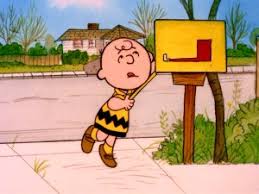
With all the technology we have today, you can write an email anytime, message someone on Facebook whenever, or even text a person in a flash. Don't get me wrong, these things are all great and come in handy when you need to send something to someone quickly. But what about the old-fashioned "snail mail?"
That's right. I said snail mail. Actual pieces of paper in envelopes put in a mailbox for you to retrieve later that day. I use to love getting mail for my birthday, Christmas, or just because. Actually, I still love getting mail. You see, there's something about seeing an envelope in the pile of mail you just lugged inside that makes the day just a little better. It sounds ridiculous, but it's true. The moment you get something hand writtten in the mail, whether it be a card, letter, or invitation, you immediately open it without hesitation. I guess what makes mail so great is that you don't really expect it. I can honestly say that I am constantly checking my emails for updates on meetings, practice, games, etc. Rarely is there ever something that makes me smile or enlightens my day. The reason being, I think, is that we expect to get these kinds of notifications. Mail, on the other hand, leaves us to be surprised everytime because we do not expect to get any most of the time. Being surprised by a letter and knowing that someone took the time to write it and make it perfect, now that's something technology can't give.
With all the technology we have today, you can write an email anytime, message someone on Facebook whenever, or even text a person in a flash. Don't get me wrong, these things are all great and come in handy when you need to send something to someone quickly. But what about the old-fashioned "snail mail?"
That's right. I said snail mail. Actual pieces of paper in envelopes put in a mailbox for you to retrieve later that day. I use to love getting mail for my birthday, Christmas, or just because. Actually, I still love getting mail. You see, there's something about seeing an envelope in the pile of mail you just lugged inside that makes the day just a little better. It sounds ridiculous, but it's true. The moment you get something hand writtten in the mail, whether it be a card, letter, or invitation, you immediately open it without hesitation. I guess what makes mail so great is that you don't really expect it. I can honestly say that I am constantly checking my emails for updates on meetings, practice, games, etc. Rarely is there ever something that makes me smile or enlightens my day. The reason being, I think, is that we expect to get these kinds of notifications. Mail, on the other hand, leaves us to be surprised everytime because we do not expect to get any most of the time. Being surprised by a letter and knowing that someone took the time to write it and make it perfect, now that's something technology can't give.
Tuesday, October 29, 2013
A Halloween Tradition
Ever since I can remember, during the time of Halloween, my mom would break out the scary story Cds, “Halloween party music”, and those with the random scary sounds on them. It might sound silly to may people but like I said before, we were always the house with the scary music playing while the fog machine was going off while treat-or-treaters were coming up to the door. I never thought much of it, but now I realize that all of these Halloween CDs are part of every Halloween memory I have. One CD in particular, the one with the “scary” stories narrated by one man trying to speak in different voices for all of the parts, recently had me thinking: What made stuff like this seem so scary to me years ago?
The answer is quite simple. Between the rise and falling of each voice and the occasional sounds effects, these digital stories swept me up and transported me into their creepy world. And isn’t that what makes stories so scary? If you can successfully adjust your voice to the mood and add in a few scary sound effects, you can easily scare anyone. I guess that’s way flashlights lightening up the storyteller’s face at a campfire while telling scary stories is so effective. When our minds hear certain words, tones of voice, or even certain sound effects, we are immediately pulled into the story being told. So if you happen to hear scary music, creepy voices, or frightfully intriguing stories this Halloween, pay attention to every element so you can see exactly how far you are drawn into the setting of that specific moment.
Ever since I can remember, during the time of Halloween, my mom would break out the scary story Cds, “Halloween party music”, and those with the random scary sounds on them. It might sound silly to may people but like I said before, we were always the house with the scary music playing while the fog machine was going off while treat-or-treaters were coming up to the door. I never thought much of it, but now I realize that all of these Halloween CDs are part of every Halloween memory I have. One CD in particular, the one with the “scary” stories narrated by one man trying to speak in different voices for all of the parts, recently had me thinking: What made stuff like this seem so scary to me years ago?
The answer is quite simple. Between the rise and falling of each voice and the occasional sounds effects, these digital stories swept me up and transported me into their creepy world. And isn’t that what makes stories so scary? If you can successfully adjust your voice to the mood and add in a few scary sound effects, you can easily scare anyone. I guess that’s way flashlights lightening up the storyteller’s face at a campfire while telling scary stories is so effective. When our minds hear certain words, tones of voice, or even certain sound effects, we are immediately pulled into the story being told. So if you happen to hear scary music, creepy voices, or frightfully intriguing stories this Halloween, pay attention to every element so you can see exactly how far you are drawn into the setting of that specific moment.
Tuesday, October 15, 2013

“There is something about words. In expert hands, manipulated deftly, they take you prisoner. Wind themselves around your limbs like spider silk, and when you are so enthralled you cannot move, they pierce your skin, enter your blood, numb your thoughts. Inside you they work their magic.”
Diane Setterfield, The Thirteenth Tale
Diane Setterfield, The Thirteenth Tale
Words. They are all around us. We use them day and night to share thoughts, feelings, instructions and knowledge. But just how powerful can words actually be? If used correctly, words can move mountains, break down barriers, and point out injustice. They can create want, determination, fear, and sadness just by how they are used and placed in sentences. The way syllables are pronounced and strung together also create the emotion behind the word. When we hear a speech, see a movie, or listen to a song, the words that create these things are what make them a complete success or a complete failure. Words that are merely thrown together without thought or feeling behind them hardly convey the emotion in which they are capable of. Sometimes the best speeches and pieces of writing use the simplest of words; however, often times, they convey the strongest emotion. The video below is a video that meshes together many incredible and emotion filled sports speeches from movies, many in which are true stories.
For me personally, the way someone speaks and writes is what makes or breaks their ability to influence others. I have listened to amazing stories told by war veterans, Holocaust survivors and their families, and many, many sports speeches in my life. All of which have influenced me in one way or another due to the various emotions in which they conveyed. If it were not for such strong emotion behind these words, I would have not been as influenced as I was at the end of each speech.
Monday, September 30, 2013
Sports Jargon
Okay, so it’s Super Bowl Sunday and you were just invited to one of the biggest parties in the neighborhood. You can’t wait for the endless bowls of chips and dip, the spicy taco dip, the grilled burgers and hotdogs, and the cookie cake decorated with the colors and logos of the teams competing in this year’s game on it. You have your game day attire on: your worn-out jersey, your lucky socks that you haven’t washed all season, and your lucky underwear that nobody knows about. Not to mention, you get there early to claim your spot for the day. The game starts and all you hear is that one person in the room asking everything from “What’s that yellow thing the ref’s throwing” to “What’s a QB?” Eventually, you get so annoyed by this person’s lack of understanding of the game that you grab the taco dip and run to the nearest department store’s TV section to the watch the rest of the game.
Obviously the whole department store scenario is a little extreme, but I’m not going to judge… As it turns out, the person who ruined your entire game-day experience was not up to par on the football jargon. But let’s take a step back for a moment shall we… Jargon is the use of certain words and phrases by a specific group of people that only that group knows and understands. So obviously this certain person at the party did not get any of the jargon used by every football fan in the room. This happens all the time when it comes to sports and even life. Fans of one sport may or may not have any idea of what the terms of another sport mean and vice-versa. This can lead to confusion, misunderstanding, and not to mention embarrassment. By taking the time to observe and learn the language or jargon of another group, we can not only expand our knowledge and vocabulary, but also prevent the embarrassment of being that one annoying football “fan.” A good example of jargon can be found in this video showing the views of typical British teenagers’ knowledge about American football and the NFL.
(Skip to about 2:45 for the main point)
Anyway, the entire point of the video was to show how the terminology in the game known as American Football is almost only known in America. It’s pretty obvious that our football is entirely different then what the British understand as football (aka soccer). Just by watching the video, the jargon used in the game of American football is not understood by those who do not watch the game. This video illustrates perfectly how people react to terms in which they have no idea what they mean. Just from this video, you can see just how important keeping an open mind to the jargon of other groups is in terms of becoming more knowledgeable about that group and its “language.”
This next two videos are my personal favorites and show how knowing the jargon of a sport is crucial to being a fan of that sport…or a coach for that matter. Do not end up like this guy…
Wednesday, September 18, 2013
The book Lord of the Flies, written by William Golding, is a literary masterpiece that illustrates the idea of nature vs. nurture. Throughout the entire story, the reader sees how humans base their behavior on their own nature or the nurture they received from the time of their birth. When it comes to the idea of nature vs. nurture; however, nurture tends to play a much bigger role in our lives than nature.
The story Lord of the Flies revolves around a group of private school boys who are stranded on an island when their plane crashes. Soon after the boys all find each other, they begin setting up their own “mini society.” This “mini society” contains rules to provide fairness, equality, leadership, and job distribution to ensure their survival. Furthermore, there is no doubt that the children did not come up with these aspects of society on their own. In the words of one of the main characters, Piggy, "How can you expect to be rescued if you don’t put first things first and act proper?"
This is where the idea of nurture comes into play. Further examination of the boys would suggest that they were the product of at least middle-class parents with a private school education. With this in mind, it can be said that the boys had utilized the insight of their parents, teachers, and environment at home in order to come up with their own society on the island. Without the knowledge and views provided through the boy’s parents and education, it can be inferred that they would not be able to come up with the working society that they did. In fact, without nurture, would the boys even be able to survive?
The answer to this question can be argued either way. It is possible that human nature could have kicked into high gear and turned the boys into savages and primitive beings (which it did by the end of the novel) or the boys could have suffered from a lack of knowledge and died much quicker and earlier in the novel. Furthermore, without the main characters, there would be no story. Thus, nurture is very important in our lives. Nurture is what causes us to be who we are as human beings and guides us to be the individuals that we eventually become. As far as writing goes, where would we be without the guidance of our teachers or the brilliant works of those before us? I know that my writing is a combination of every teacher and book I have read throughout my life. Although the idea of nurture is sometimes believed to be conforming, it is the pieces of knowledge that we choose to live by that make us individuals. We choose what we, as our own person, how we want to live through the nurture we receive. Thus, we choose who or what influences us the most in order to choose what we believe, think, and create in lives.
The story Lord of the Flies revolves around a group of private school boys who are stranded on an island when their plane crashes. Soon after the boys all find each other, they begin setting up their own “mini society.” This “mini society” contains rules to provide fairness, equality, leadership, and job distribution to ensure their survival. Furthermore, there is no doubt that the children did not come up with these aspects of society on their own. In the words of one of the main characters, Piggy, "How can you expect to be rescued if you don’t put first things first and act proper?"
This is where the idea of nurture comes into play. Further examination of the boys would suggest that they were the product of at least middle-class parents with a private school education. With this in mind, it can be said that the boys had utilized the insight of their parents, teachers, and environment at home in order to come up with their own society on the island. Without the knowledge and views provided through the boy’s parents and education, it can be inferred that they would not be able to come up with the working society that they did. In fact, without nurture, would the boys even be able to survive?
The answer to this question can be argued either way. It is possible that human nature could have kicked into high gear and turned the boys into savages and primitive beings (which it did by the end of the novel) or the boys could have suffered from a lack of knowledge and died much quicker and earlier in the novel. Furthermore, without the main characters, there would be no story. Thus, nurture is very important in our lives. Nurture is what causes us to be who we are as human beings and guides us to be the individuals that we eventually become. As far as writing goes, where would we be without the guidance of our teachers or the brilliant works of those before us? I know that my writing is a combination of every teacher and book I have read throughout my life. Although the idea of nurture is sometimes believed to be conforming, it is the pieces of knowledge that we choose to live by that make us individuals. We choose what we, as our own person, how we want to live through the nurture we receive. Thus, we choose who or what influences us the most in order to choose what we believe, think, and create in lives.
Subscribe to:
Posts (Atom)